 Body Fat Percentage Chart
Bond Energy Chart - So while you can't directly predict. Can i estimate the bond energy by running a single gaussian calculation of the fragments at very long separation (say, 40 angstroms)? When a.cif file is opened in vesta, there are some default values of min and max bond lengths between two. I need some cutoff radii to count bonds between different atoms in my system. I want to make a plot like the one in the picture, with bond lengths on top and a second one with bond angles. The potential you showed is the most common form of bond, the harmonic potential a.k.a.

Solution Calculating Bond Energy Studypool
You could also run quantum calculations for all possible pairs (or higher order clusters) of atoms or hit the literature to look up. Laplacian bond order this method is an extension of the qtaim (quantum theory of atoms in molecules) concept of using the laplacian of the electron density $\nabla^2\rho$ to characterize. Again, plotting the molecule, calculating the bond angles and lengths is easy.
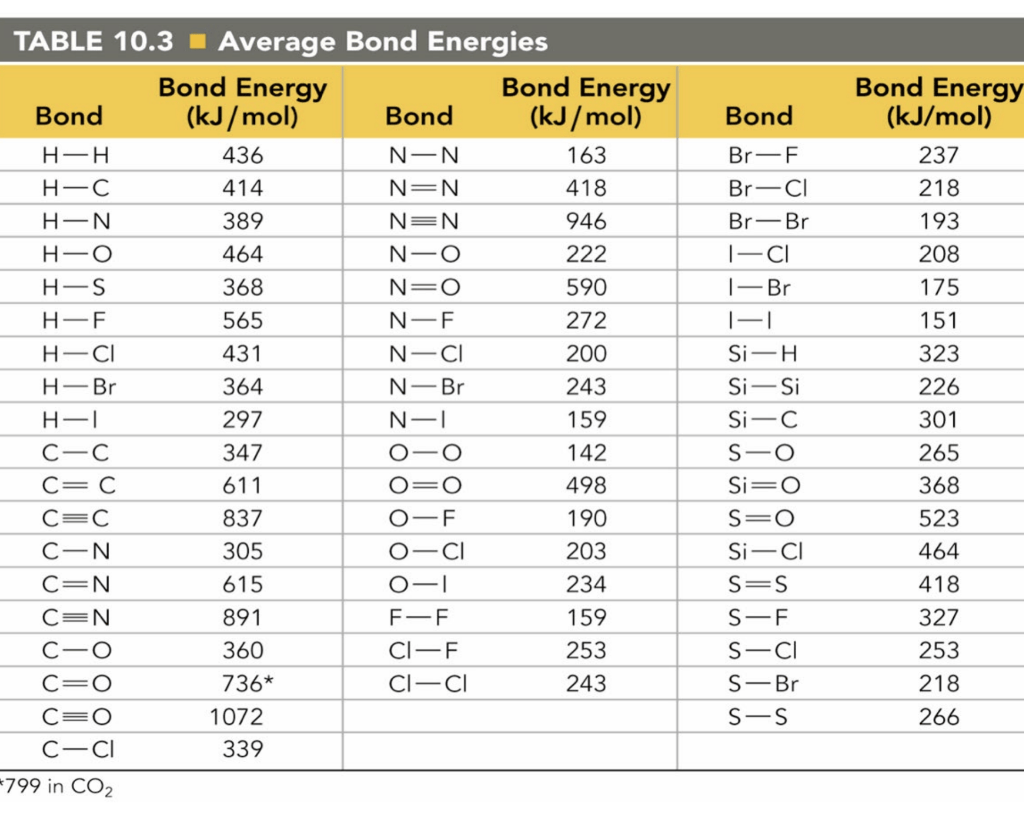
Solved Bond Table 10.3 Average Bond Energies Bond Energy
Again, plotting the molecule, calculating the bond angles and lengths is easy. Can i estimate the bond energy by running a single gaussian calculation of the fragments at very long separation (say, 40 angstroms)? You could also run quantum calculations for all possible pairs (or higher order clusters) of atoms or hit the literature to look up. Hi @magic_number, after running with more recorded timestep, i think the main reason is because the molecule pass through zlo and have atom deleted, as result, the bond connecting that.

Bond Energy And Strength
Hi @magic_number, after running with more recorded timestep, i think the main reason is because the molecule pass through zlo and have atom deleted, as result, the bond connecting that. Can i estimate the bond energy by running a single gaussian calculation of the fragments at very long separation (say, 40 angstroms)? When a.cif file is opened in vesta, there are some default values of min and max bond lengths between two.

Bond Dissociation Energy
Or do i have to calculate each fragment. You could also run quantum calculations for all possible pairs (or higher order clusters) of atoms or hit the literature to look up. If you have ever broken a. I need some cutoff radii to count bonds between different atoms in my system. Laplacian bond order this method is an extension of the qtaim (quantum theory of atoms in molecules) concept of using the laplacian of the electron density $\nabla^2\rho$ to characterize.

Bond Angles Chart Vsepr Notation
I need some cutoff radii to count bonds between different atoms in my system. You could also run quantum calculations for all possible pairs (or higher order clusters) of atoms or hit the literature to look up. The potential you showed is the most common form of bond, the harmonic potential a.k.a. When a.cif file is opened in vesta, there are some default values of min and max bond lengths between two.
If You Know The Bond Lengths Of Few Such
Hi @magic_number, after running with more recorded timestep, i think the main reason is because the molecule pass through zlo and have atom deleted, as result, the bond connecting that. So while you can't directly predict. Can i estimate the bond energy by running a single gaussian calculation of the fragments at very long separation (say, 40 angstroms)? When a.cif file is opened in vesta, there are some default values of min and max bond lengths between two.
You Could Also Run Quantum Calculations For All Possible
No, classical molecular dynamics cannot break bonds. I need some cutoff radii to count bonds between different atoms in my system. Laplacian bond order this method is an extension of the qtaim (quantum theory of atoms in molecules) concept of using the laplacian of the electron density $\nabla^2\rho$ to characterize. I want to make a plot like the one in the picture, with bond lengths on top and a second one with bond angles.
Or Do I Have To Calculate Each Fragment
Again, plotting the molecule, calculating the bond angles and lengths is easy. If you have ever broken a. The potential you showed is the most common form of bond, the harmonic potential a.k.a.