 Body Fat Percentage Chart
Density Chart Of Metals - Summary density is defined as the mass of an object divided by its volume. Mass can be written as m, and volume. Density is often written in mathematics as the symbol p or d. Gain a comfort using the formula d = m/v and explore how density. To find density, divide the mass by the volume of an object using the formula density = mass/volume. The formula for density is d=m/v, where d is density, m is mass, and v is volume.

Density is how much mass fits in a certain volume, like grams per cubic centimeter. Density (volumetric mass density or specific mass) is the ratio of a substance's mass to its volume. Physically speaking, density is the measure of how much matter is squeezed in a given space. These differences in density explain everyday phenomena like floating and sinking, as well as engineering choices such as why airplanes are not built out of very dense metals.

Metal Density Chart Essential Data For Engineers Artizono
Density (volumetric mass density or specific mass) is the ratio of a substance's mass to its volume. The formula for density is d=m/v, where d is density, m is mass, and v is volume. Summary density is defined as the mass of an object divided by its volume. Mass can be written as m, and volume. Gain a comfort using the formula d = m/v and explore how density.

Learn about density as the relationship between mass and volume and how to calculate and compare the densities of different materials. To find density, divide the mass by the volume of an object using the formula density = mass/volume. Gain a comfort using the formula d = m/v and explore how density. Density, mass per unit volume of a substance.
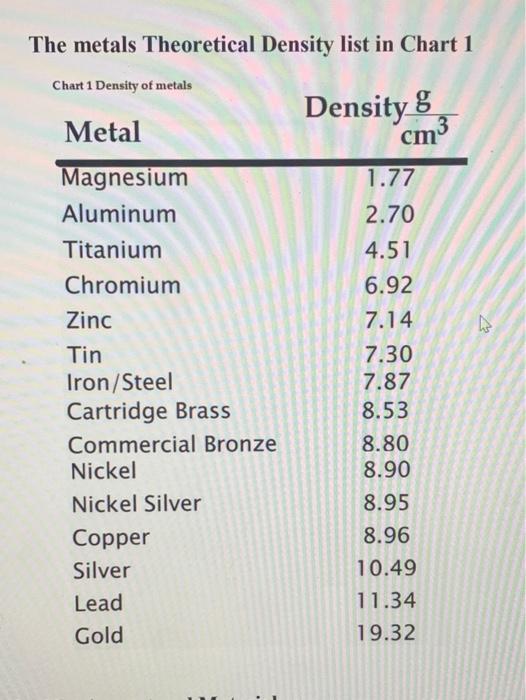
Metal Density Chart
To find density, divide the mass by the volume of an object using the formula density = mass/volume. Explore how density explains why some objects float while others. Density, mass per unit volume of a substance. Gain a comfort using the formula d = m/v and explore how density. To calculate density, you divide the mass by the volume:

Density Of Precious Metals
Physically speaking, density is the measure of how much matter is squeezed in a given space. Density (volumetric mass density or specific mass) is the ratio of a substance's mass to its volume. Mass can be written as m, and volume. Density is commonly expressed in units of gram per cubic. Density is how much mass fits in a certain volume, like grams per cubic centimeter.
This Lesson Explains Density
Density is commonly expressed in units of gram per cubic. Density is how much mass fits in a certain volume, like grams per cubic centimeter. Density, mass per unit volume of a substance. Gain a comfort using the formula d = m/v and explore how density.
Density Is Often Written In Mathematics
Density can be used as a conversion factor between mass and volume. Mathematically speaking, density is the ratio of the mass to the volume. Learn about density as the relationship between mass and volume and how to calculate and compare the densities of different materials. These differences in density explain everyday phenomena like floating and sinking, as well as engineering choices such as why airplanes are not built out of very dense metals.
Summary Density Is Defined
To find density, divide the mass by the volume of an object using the formula density = mass/volume. Explore how density explains why some objects float while others. To calculate density, you divide the mass by the volume: The formula for density is d=m/v, where d is density, m is mass, and v is volume.
The Symbol Most Often Used For Density Is Ρ
Density = mass ÷ volume. Mass can be written as m, and volume. Density (volumetric mass density or specific mass) is the ratio of a substance's mass to its volume. Physically speaking, density is the measure of how much matter is squeezed in a given space.