 Seating Arrangement Guide
Miscibility Chart Solvents - Two liquids that appear to mix completely together are said to be miscible. Miscibility is the property of two substances to completely mix to form a homogeneous solution. It is a qualitative rather than a quantitative observation — such as, miscible, partially miscible, or not miscible. If two liquids are miscible, it means that they will blend with each other to form an equally distributed, homogeneous solution. They can be mixed in any proportion,. Examples of miscible liquids include:

Two liquids that do not really mix well together, such as oil and water, are described as immiscible. If two liquids are miscible, it means that they will blend with each other to form an equally distributed, homogeneous solution. Miscibility refers to the ability of two or more liquids to mix in any proportion without separating into two phases. Two liquids that appear to mix completely together are said to be miscible.

The opposite of miscible is ‘immiscible’, which means that. It is a qualitative rather than a quantitative observation — such as, miscible, partially miscible, or not miscible. Miscibility defines how substances combine (or mix) to form a homogenous solution without precipitates. Miscibility refers to the complete mixing of two substances, usually liquids, to form a homogeneous solution. They can be mixed in any proportion,.

Solvent Miscibility Chart Pdf Tetrahydrofuran Solvent Benzene
Miscibility means how completely two or more liquids dissolve in each other. They can be mixed in any proportion,. The opposite of miscible is ‘immiscible’, which means that. Miscibility most often refers to liquids but can also apply to gas. Miscibility refers to the ability of two or more liquids to mix in any proportion without separating into two phases.

Water and ethanol, for example, are miscible. Substances that are miscible can mix in any proportion or. If two liquids are miscible, it means that they will blend with each other to form an equally distributed, homogeneous solution. Miscibility is the property of two substances to completely mix to form a homogeneous solution. Miscibility most often refers to liquids but can also apply to gas.
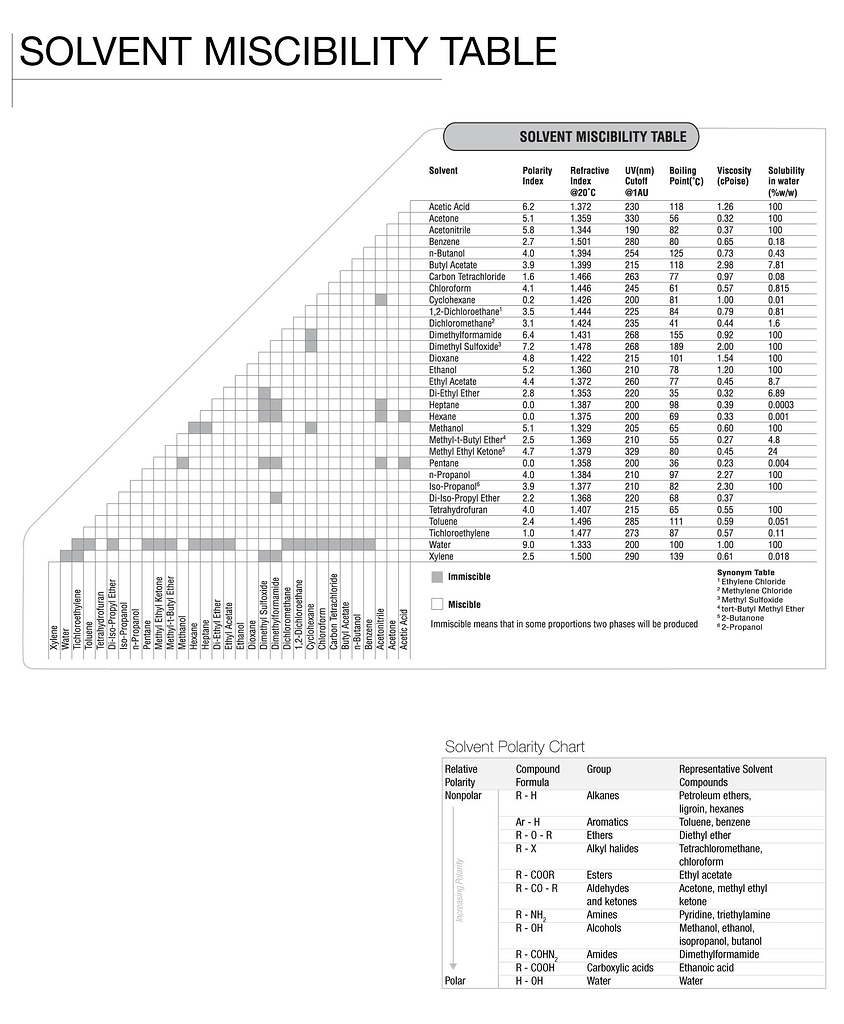
Solvent Miscibility Chart Analytical Future4200
Two liquids that appear to mix completely together are said to be miscible. The opposite of miscible is ‘immiscible’, which means that. Miscibility is the ability of two or more substances to mix uniformly in all proportions to form a single phase. Miscibility refers to the ability of two or more liquids to mix in any proportion without separating into two phases.
Usually The Term Is Used To Describe Liquid Mixtures,
It is a qualitative rather than a quantitative observation — such as, miscible, partially miscible, or not miscible. Miscibility is the property of two substances to completely mix to form a homogeneous solution. They can be mixed in any proportion,. Miscibility defines how substances combine (or mix) to form a homogenous solution without precipitates.
Miscibility Refers To The Complete Mixing Of Two Substances,
Miscibility is the ability of two or more substances to mix uniformly in all proportions to form a single phase. Two liquids that do not really mix well together, such as oil and water, are described as immiscible. Water and ethanol, for example, are miscible. Miscibility is the ability of two liquids to mix with each to form a homogeneous solution.
Miscibility (/ ˌMɪsɪˈbɪlɪti /) Is The Property Of Two
Examples of miscible liquids include: Two liquids that appear to mix completely together are said to be miscible. This property is crucial in understanding how different substances interact,. Miscibility refers to the ability of two or more liquids to mix in any proportion without separating into two phases.
Miscibility Most Often Refers To Liquids
If two liquids are miscible, it means that they will blend with each other to form an equally distributed, homogeneous solution. Miscibility means how completely two or more liquids dissolve in each other. Substances that are miscible can mix in any proportion or. The opposite of miscible is ‘immiscible’, which means that.